Home health care is supposed to keep a person out of the hospital: a nurse who checks a wound, a therapist who rebuilds strength after a fall, an aide who helps with bathing while a spouse recovers from surgery. The visits happen. The care helps. Then, weeks or months later, a letter arrives saying Medicare will not pay for part of it.
That letter is not a bill, and it is not the end of the story. It is the result of rules that Medicare applies when it reviews a home health claim, and those rules are more specific than most families expect. Knowing them turns a frightening piece of mail into a short list of questions you can ask.
What Medicare Requires Before It Pays for Home Health
Four conditions have to be true at the same time, and each one has to be written down somewhere in your medical record.
You are homebound. This is the requirement families most often misread. Homebound does not mean you never leave the house. It means leaving requires a considerable and taxing effort, or a doctor has advised against it because of your illness or injury. You can still attend religious services, go to adult day care, or be driven to a medical appointment and remain homebound for Medicare purposes.
You need skilled care, and you need it intermittently. Skilled means the work has to be done by a nurse or therapist, not by a family member with common sense. Intermittent means the need is not full-time, ongoing care. Help with bathing, dressing, and meals by itself is custodial care, and Medicare does not cover custodial care on its own.
A doctor or allowed practitioner orders and supervises a plan of care. Home health is not something a person arranges independently. A physician, nurse practitioner, clinical nurse specialist, physician assistant, or certified nurse-midwife establishes the plan and reviews it as it continues.
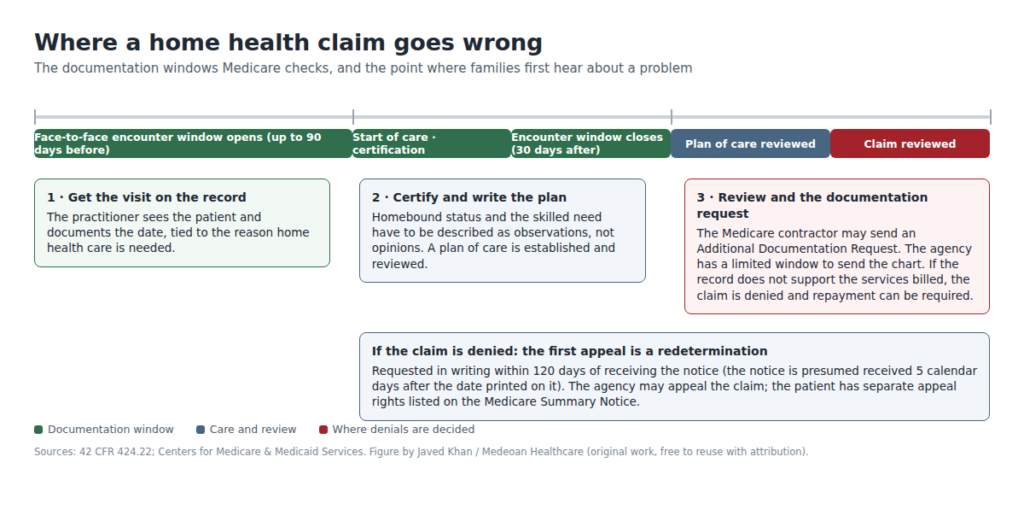
A face-to-face encounter is documented. Before certifying that you qualify, the certifying practitioner must have seen you in person, and the record must show the date of that visit and that it was related to the reason you need home health care. The encounter has to take place no more than 90 days before the start of care or within 30 days after it, under the federal rule at 42 CFR 424.22.
The agency also has to be Medicare-certified. The Medicare booklet Medicare and Home Health Care walks through all of this in plain language and is worth keeping on the kitchen table.
The Five Denials Families See Most Often
Denials look bureaucratic, but they usually trace back to a small number of gaps.
1. Homebound status was not documented, only assumed
A nurse knows the patient cannot manage the porch steps. The note says “patient prefers to stay home.” Preferences are not homebound status. The record has to describe the actual limitation: what leaving requires, what help is needed, how often it happens. When a reviewer reads the chart and finds an opinion instead of an observation, the claim is vulnerable.
2. The record does not explain why the care had to be skilled
This is the most common and the most fixable denial. The visits were skilled. The note, though, describes what was done rather than why a licensed clinician had to do it. A wound that a nurse checks is not automatically a skilled need; a wound with measurements, a change in treatment, and a documented clinical decision is.
3. The face-to-face encounter is missing, late, or unrelated
The encounter requirement fails in three ways: it never happened, it happened outside the allowed window, or it happened but concerned a different problem than the one driving the home health plan. All three are documentation problems, which means they usually cannot be repaired after the fact. They have to be caught before the claim goes out.
4. The paperwork does not tell one story
An assessment, a plan of care, and a claim that disagree about the diagnosis, the functional status, or the services ordered will be denied even when each document is accurate on its own. Reviewers compare them side by side. If the assessment describes a patient who can walk with a cane and the therapy notes describe someone who cannot stand, that inconsistency costs the claim.
5. Eligibility or authorization problems on Medicare Advantage
Medicare Advantage plans add their own prior authorization and network rules on top of the federal requirements. A service that would be covered under Original Medicare can still be denied because authorization was never obtained or because the visit fell outside the authorized frequency. Families on Medicare Advantage should ask, in writing, whether authorization is in place for each service they receive.
What Happens After the Claim Is Submitted
The claim goes to a Medicare Administrative Contractor, which may send an Additional Documentation Request, often called an ADR. That is a request for the chart, not an accusation. The agency has a limited window to respond, and if the clinical record it sends does not support the services billed, the contractor denies the claim and can require repayment.
This is why the timing of documentation matters so much. A well-kept record assembled at the time of care survives review. A record reconstructed two months later usually does not, because the details that made the care necessary are no longer recoverable.
If You Get a Denial Notice, You Have Options
The first appeal level in Original Medicare is a redetermination by the Medicare Administrative Contractor. It must be requested in writing, and there are 120 days from the date you receive the initial determination to file. The notice is presumed to arrive 5 calendar days after the date printed on it. The CMS page on redeterminations explains the two ways to file.
If the redetermination is unfavorable, the next level is a reconsideration by a Qualified Independent Contractor, and there are further levels beyond that. The agency can appeal a claim that was denied to it. Separately, you have your own appeal rights as the person who received the care, and your rights are described on your Medicare Summary Notice. If you were never told that a service might not be covered, ask the agency and the plan directly whether a notice of non-coverage was issued. That question changes who owes what.
A denial is not the same as a debt owed today. It is a decision that can be tested, often twice, before anyone is asked to pay.
Questions Worth Asking Your Home Health Agency
- Which services are you billing to Medicare for my care?
- Was a face-to-face visit documented, and what date does the record show?
- Did the plan of care change, and if so, was the change documented before the visits happened?
- If my plan is Medicare Advantage, is prior authorization on file for these visits?
- If a claim is denied, will you appeal it, and will you tell me the outcome?
- Can I have a copy of the plan of care and the visit notes?
Ask the last question in writing and keep the answer. Families who hold their own copy of the record are in a far stronger position than families who rely on the agency to produce it later.
What to Keep at Home
A single folder is enough. Put the plan of care in it. Add every notice that mentions non-coverage, every statement, and a one-page log of visits with dates, who came, and what they did. If a denial letter arrives, note the date it arrived rather than the date printed on it, because deadlines run from receipt. That one habit protects appeal rights that are easy to lose by accident.
The Takeaway
Home health denials are rarely about the quality of the care. They are about whether the record shows what Medicare requires: a homebound patient, a genuine skilled need, a documented face-to-face encounter, and paperwork that agrees with itself. Families cannot write those notes, but they can ask whether they exist, keep their own copies of the answers, and make sure an appeal is filed inside the deadline when a claim goes wrong.
About the author
Javed Khan writes about home health documentation and revenue cycle operations for Medeoan Healthcare, which works with home health agencies on clinical documentation review and denial management. He can be reached at javedkhanofficial077@gmail.com.